The Government of India has taken a significant step toward decarbonising its fertiliser sector by issuing an Expression of Interest (EOI) for green urea production. The EOI was issued by the Department of Fertilisers, and then followed with a high-level pre-EOI stakeholder meeting at the Projects and Development Limited (PDIL) office in Noida. This is seen as the first formal move toward what officials describe as India's first commercial roadmap for integrating renewable energy, green hydrogen, green ammonia, and carbon capture into domestic urea manufacturing.
At present, the framework remains under industry consultation and is yet to be finalised. The differential-pricing mechanism, incentive tapering, and procurement terms are still being worked out with stakeholders.
The initiative draws on the National Green Hydrogen Mission (NGHM), whose Ministry of New and Renewable Energy (MNRE) allocation of INR 19,744 crore (US$ 2.3 billion) is intended to accelerate the broader green energy infrastructure this plan depends on. India currently imports nearly 10 million tons of urea annually, while many domestic production facilities are more than 30 years old, creating a strong case for modernisation.
The proposed framework combines long-term demand assurance with production incentives. The government plans to bridge the cost difference between green and conventional feedstock for fertiliser manufacturers, while offering developers long-term procurement agreements and financial support under the NGHM's producer-side incentive scheme.
This framework is designed to address one of the biggest barriers to green fertiliser production: secure offtake. Long-term policy support, if implemented as proposed, would reduce market risk and give project developers – and their financiers – greater confidence.
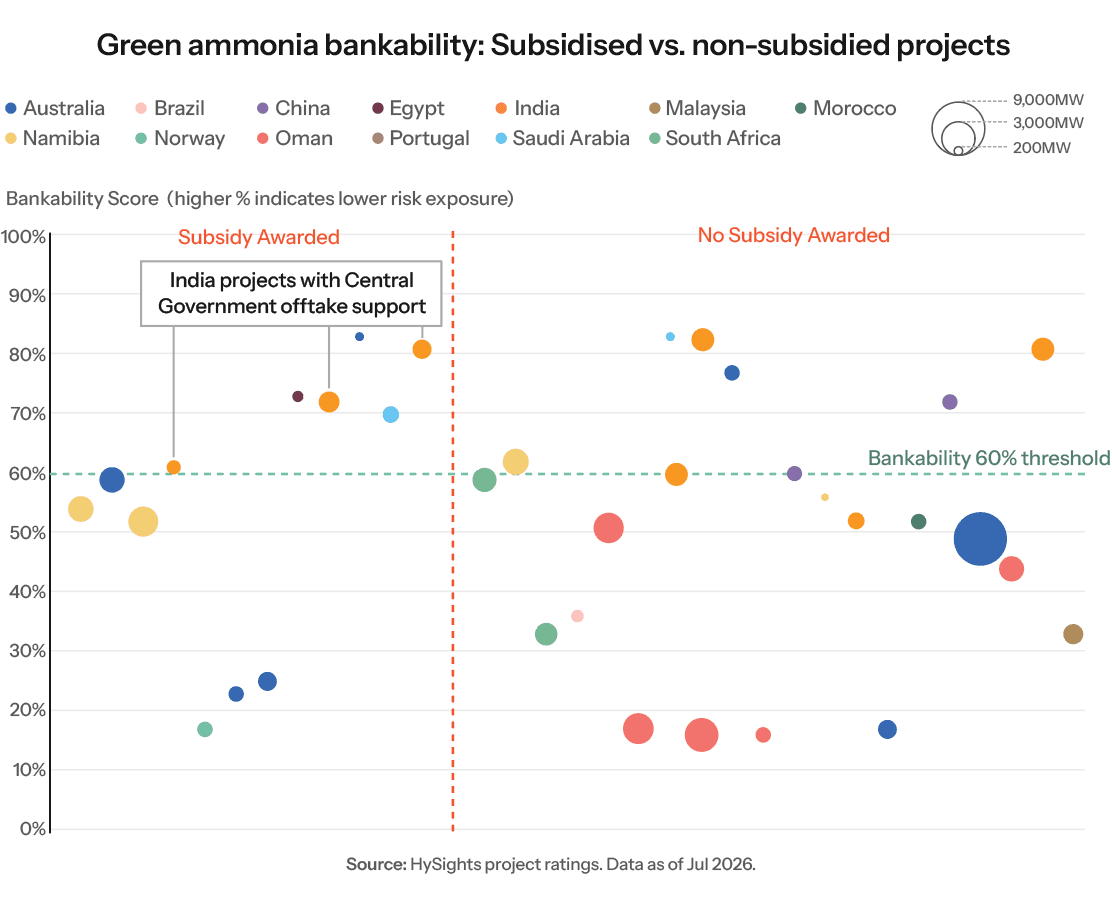
Of the 32 green ammonia projects rated by HySights, 12 have received government subsidy — three in India, with Bankability ratings of B (two projects) and C (one project). Six of the 12 subsidised projects fall above the threshold bankability score of 60. India's projects rate comparatively well as they are bolstered by government-backed offtake agreements, with state support via both subsidy and secured demand contributing to a higher Bankability score compared to unsupported projects.
The larger challenge now though, is no longer hydrogen production, but carbon management. A large-scale plant producing 1.27 million tonnes of urea each year would need nearly 1 million tonnes of CO2 annually. Thermal power plants, cement plants, and steel facilities offer potential carbon sources, but India does not yet have the infrastructure to capture, transport, and use CO2 at this scale.
The pre-EOI meeting has already drawn strong turnout from developers and technology suppliers – an indicator that the EOI is generating real interest, not just theoretical bankability. Early investments are likely to concentrate in integrated industrial clusters where renewable power, hydrogen production, carbon capture, and fertiliser manufacturing can be developed together.
Commercial deployment will likely progress in phases starting with demonstration projects like the NTPC's 150 tpd pilot plant at Pudimadaka which will help establish technical feasibility, while large-scale investment will depend on regional carbon capture infrastructure being built out. By this assessment, that makes it more realistic to expect commercial-scale green urea production in the early 2030s than immediately after this EOI closes.
The next phase of policy should extend beyond hydrogen incentives to develop a national carbon management ecosystem. India is already moving in this direction with a proposed INR 20,000 crore (US$2.3 billion) carbon capture, utilisation and storage (CCUS) initiative announced in the 2026–27 Union Budget, including an initial allocation of INR 500 crore (US$58 million) for FY2026–27, while the scheme awaits final Cabinet approval.
Together with the green urea roadmap, this signals a broader shift toward enabling the carbon value chain. Establishing robust frameworks for carbon capture, transport, utilisation and storage, backed by targeted financial incentives, will be essential to commercialising green urea and creating a scalable domestic market for low-carbon fertilisers.
For developers, project location is key to determining competitiveness. Facilities co-located with major industrial CO2 emitters stand to benefit from lower feedstock costs, simpler logistics, and stronger long-term economics.
With this roadmap, India is moving beyond supporting green hydrogen production on its own, and toward building integrated green industrial value chains. The policy foundation is being laid down. What remains is building the carbon infrastructure that will ultimately determine whether green urea becomes commercially viable at scale.
Learn more about HySights Ratings
To request a demo or HySights Ratings methodology, reach us at contact@hysights.com
Access market insights